Astraal: A Luxury Sans Serif Font for Handmade Brands
If you’ve ever spent hours tweaking a label, adjusting kerning on a wedding invitation, or testing how a font cuts on your Cricut—only to find it looks flat or forgettable—you’ll understand why Astraal feels like finding the right stitch in hand embroidery: precise, intentional, and quietly powerful. This isn’t just another clean sans serif font. Astraal is a modern typography tool built for makers who sell real things—physical products with soul, digital downloads with polish, and brand identities that resonate before a single word is read.
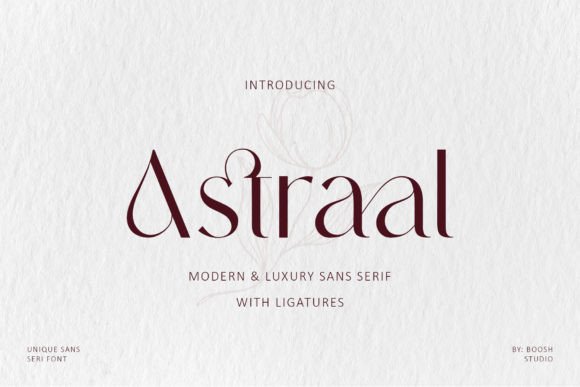
Astraal’s personality lives in its quiet confidence. It’s sleek without being cold, elegant without being fussy, and distinctly contemporary while still feeling timeless. The subtle ligatures—like the graceful connection between “f” and “i”, or “t” and “h”—aren’t decorative flourishes; they’re functional elegance. They smooth out rhythm, improve readability at small sizes, and add that intangible “premium” feel customers associate with boutique quality. Whether you're designing a minimalist candle label or a gold-foiled welcome board for a South Asian wedding, Astraal carries weight and warmth in equal measure.
For physical product creators, Astraal shines where clarity and character must coexist. Think of it on a 1.5-inch kraft paper tag for handmade soap—it remains legible, crisp, and refined even when scaled down. On a 24"x36" farmhouse-style wall sign? Its open letterforms and balanced spacing ensure impact from across the room. I’ve used it for boutique tea packaging, and customers consistently comment on how “thoughtful” the branding feels—even before tasting the blend. That’s Astraal working silently in your favor: elevating perceived value through intelligent design.
It’s especially effective for short-form, high-impact uses: names on baby milestone cards, titles on printable planner pages, monograms on linen napkins, or shop name decals on ceramic mugs. Because Astraal is a true sans serif font—not overly geometric nor too humanist—it avoids the stiffness of ultra-modern typefaces and the informality of rounded sans fonts. That balance makes it ideal for invitations where tone matters: a Diwali card needs reverence and joy; a bridal shower invite demands grace and energy. Astraal delivers both—without needing extra styling.
Readability for cutting machines is a real concern—and Astraal handles it beautifully. Its generous counters (the open spaces inside letters like “a”, “e”, and “o”) and consistent stroke weight prevent tiny details from vanishing during vinyl cutting or laser engraving. When I tested it on 0.25-inch sticker sheets for mini spice jar labels, every character cut cleanly—even “r”, “s”, and “g”, which often ghost or break on less-engineered fonts. For printables, it renders crisply at 72 dpi for screen previews and holds sharpness up to 300 dpi for professional printing. No blurry edges, no unexpected gaps.
Pairing Astraal thoughtfully unlocks even more creative range. Try it with a delicate handwritten font for greeting cards—Astraal as the headline (“You’re Invited”), the script as the body (“Join us Sunday, May 12…”). Or pair it with a soft serif font for wedding stationery suites, letting Astraal anchor headings while the serif adds narrative warmth in paragraphs. If you’re designing SVG files for layered t-shirt graphics, use Astraal’s bold weight for the main phrase and a light script for an accent word (“Celebrate” + “with love”). These combinations don’t compete—they converse.
What sets Astraal apart from other premium fonts is how intentionally it serves the craft workflow. It includes OpenType features like stylistic alternates and contextual ligatures—meaning your design software can automatically swap in smoother connections where appropriate, saving time and improving consistency across dozens of product variations. It supports extended Latin characters, so names with accents (like “José”, “Naïve”, or “Résumé”) render correctly on international orders or multilingual packaging. And because it’s delivered in standard OTF and TTF formats, it installs seamlessly on Windows, Mac, and works reliably in Cricut Design Space, Silhouette Studio, Canva, and Adobe Creative Cloud.
Licensing is non-negotiable when you’re selling physical goods or digital assets—and Astraal comes with a clear commercial license. You’re covered to use it on product labels, printed invitations, SVG cut files sold on Etsy, editable Canva templates, branded merchandise (totes, mugs, apparel), client projects, and social media graphics for your shop. No hidden restrictions. No need to track impressions or purchases. Just confident, legal usage—so you can focus on making, not worrying.
I reached for Astraal recently when designing a set of printable Diwali wall art—three minimalist phrases in English and Hindi transliteration. Its clean lines let the meaning breathe, while the ligatures gave each title a subtle flow, like ink trailing just right. Customers told me those prints felt “calm but celebratory”—exactly the emotional note we aimed for. That’s the quiet strength of a well-chosen sans serif font: it doesn’t shout. It settles in, earns trust, and makes your handmade work feel unmistakably yours.
Whether you're launching your first Etsy shop or refining a decade-old brand identity, Astraal is more than a typeface. It’s a consistency tool, a perception shaper, and a practical ally in every stage—from mockup to marketplace. It works as hard as you do, adapting to stickers and signs, printables and packaging, without losing its polished, luxurious core. In a world flooded with generic fonts, choosing Astraal is choosing intention. And in handmade business, intention is the first stitch in everything that follows.